


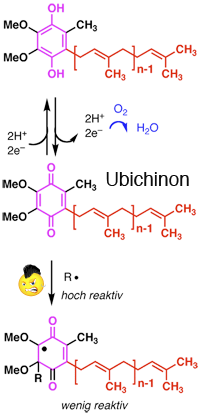
 Q10, auch als Ubichinon bekannt, ist ein Chinonderivat mit lipophilen Isoprenoid-Seitenketten. Der Grundkörper besteht aus einem 1,4–Benzochinon, daran angeknüpft befindet sich eine Isoprenoid Seitenkette. Benannt wird die Struktur dann nach der Anzahl der Isopreneinheiten. Beim Menschen ist n = 10, wodurch sich der Name Q10 erklärt.
Bei Q10 oder Ubichinon handelt es sich um ein so genanntes Coenzym, das heißt, es wird zu biochemischen Vorgängen im Körper eingesetzt. Q10 kann nicht nur über die Nahrung aufgenommen werden, sondern der Körper ist vielmehr selbst in der Lage, Ubichinon zu produzieren.
Ubichinon ist Bestandteil der Zellen der Mitochondrien oder genauer ihrer Biomembran, in die es sich mit Hilfe langen Isoprenoid-Seitenkette verankert. Dort läuft die Atmungskette, einer der wichtigsten Teile des Energiestoffwechsels bei Lebewesen, ab. Dabei werden stufenweise Elektronen und Protonen auf Sauerstoff übertragen bei gleichzeitigen Gewinnung von Energie, die chemisch als ATP gespeichert wird. Ubichinon als Coenzym dient als Vermittler in diesen Prozessen. Bei diesem Vorgang, welcher auch unter dem Begriff oxidative Phosphorylierung bekannt ist, wird über 95% der gesamten Körperenergie erzeugt. Das ist auch der Grund dafür, dass man die höchste Q10 Konzentration in den Organen Herz, Lunge und Leber findet, da sie den höchsten Energiebedarf im menschlichen Körper haben. Für die Aufklärung der Funktion von Q10 in der Atmungskette erhielt der britische Biochemiker Peter Dennis Mitchell 1978 den Nobelpreis für Chemie.
 Doch auch als Antioxidans arbeitet Q10. Wenn der in den Zellen umgesetzte Sauerstoff nicht vollständig zu Wasser umgebaut wird, entstehen so genannte freie Radikale. Diese Teilchen sind sehr reaktiv und verursachen in der Zelle Kettenreaktionen, die diese schädigen oder zu stofflichen Veränderungen führen. Genau dieser Vorgang ist es auch, der unsere Haut altern lässt. Ubichinon ist jedoch in der Lage, diese Radikale durch Addition an die Benzochinoneinheit unschädlich zu machen und somit die Aufgabe der Zellschutzfunkion wahrzunehmen.
Die Q10 Konzentration im Körper ist jedoch nicht ein Leben lang gleichbleibend. Körperliche Anstrengungen, Stress, erhöhter Alkoholkonsum, aber auch einfach die Zunahme des Alters führen zu einer Verminderung des natürlich vorhandenen Q10.
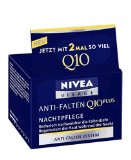
 Vor allem der zuletzt genannten Punkt begründet den Einsatz von Q10 in Anti Aging Cremes. Die Haut ist das größte Organ des Menschen und damit jeder Menge Stress ausgesetzt. Da im Alter die Konzentration von Q 10 abnimmt, können die durch den Stress produzierten Radikale nicht mehr abgebaut werden: Hautalterung ist die Folge. Durch antioxidierende Hautcremes versucht man, diesem Problem entgegenzuwirken. Die Hautzelle soll durch die Q10-Cremes genug Energie erhalten, um sich gegen die Umwelteinflüsse zur Wehr zu setzen, zusätzlich sollen die entstehenden Radikale neutralisiert werden. Doch nicht nur Cremes sondern auch Q10 Nahrungsergänzungsmittel halten langsam Einzug auf dem deutschen Verjüngungsmarkt. Das Coenzym kann in Form von Kapseln eingenommen werden, was nachweislich eine Erhöhung der Q10 Konzentration im Körper bewirkt. Die empfohlene Tagesdosierung bei einem Erwachsenen liegt zwischen 30 und 200 mg.
Sofern man sich ausgewogen ernährt, ist die Q10 Konzentration im Körper normal. Öliger Fisch, bevorzugt Makrelen oder Sardinen, Nüsse, Hülsenfrüchte, Sonnenblumenkerne oder auch das Fleisch von Organen wie das der Leber stellen eine ausreichende Quelle für Q10 dar. Dagegen können Statine, die Wirkstoffe in verschreibungspflichtigen Medikamenten wie Sortis™ (Lipitor™) zur Senkung des Cholesterinsspiegel, die natürliche Q10 Produktion hemmen.
Die Einnahme von Q10 - innerlich wie äußerlich - kann daher durchaus für viele Menschen sinnvoll sein. Langzeitstudien haben gezeigt, dass selbst eine Einnahme von 900 mg Q10 pro Tag sicher ist.
Artikel zum Thema:
Wenn die Haare nicht mehr sprießen | Schlankheitsmittel_Carnitin_-_was_dahinter_steckt | Aminopeptide - kosmetische Wunderwaffe oder Werbegag? | Hyaluronsäure - das Geheimnis praller Haut

