Oliver Reiser
 Handystrahlung ist schon für alles möglich verantwortlich gemacht worden: Hirntumoren, Krebs, ein geschwächtes Immunsystem sind nur einige Gefahren, die heraufbeschworen werden, ohne dass es hierfür allerdings fundierte wissenschaftliche Beweise gab. Selbst vor der wesentlich schwächeren Strahlung der WLAN Netze hat - initiiert durch die Grünen - unsere Bundesregierung vor kurzem gewarnt. Eine neue Studie kommt jetzt allerdings zu dem Ergebnis, dass Handystrahlung durchaus einen positiven Effekt auf Gehirne - zumindest bei Mäusen - hat.
 Eine Studie von amerikanischen, japanischen und chinesischen Wissenschaftlern lässt Handystrahlung in einem neuen Licht erstrahlen: Die Wissenschaftler setzte Mäuse für eine Stunde pro Tag über einen Zeitraum von 9 Monaten der typischen Handyfrequenz und Intensität aus und fanden erstaunliches heraus. Bei Mäusen, die bereitsan an Alzheimer litten, trat durch die Handystrahlung eine deutliche Besserung auf. Mäuse, die aufgrund einer genetischen Manipulation normalerweise Alzheimer mit der Zeit entwickeln, trat die Erkrankung nicht oder deutlich abgeschwächt ein. Und bei gesunden Mäusen bewirkte die Handystrahlung eine Verbesserung der Gedächtnisleistung.
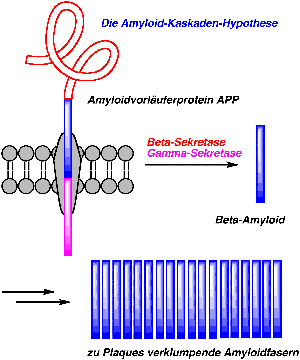 Die molekulare Entstehung von Alzheimer ist recht gut verstanden: Als Hauptverdächtiger wurde eine Peptid, das so genannte Beta-Amyloid identifiziert, das sich im Gehirn durch Mutationen bestimmter Gene bildet. Es wird aus dem Amyloidvorläuferprotein APP, das in Membranen von Gehirnzellen sitzt, durch zwei Enzyme, den so genannten Beta- und Gamma-Sekretasen - in kleinere Teile zerschnitten. Dabei entsteht außerhalb der Zellen Beta-Amyloid: Dieses Peptid hat wasserabweisende Seitenketten was zur Folge hat, dass im wässrigen Milieu zwischen den Nervenzellen sich die einzelnen Peptidmoleküle zu größeren Gebilden - den berüchtigten schwerlöslichen Plaques, die sich dann im Gehirn ablagern - zusammenfinden. Warum diese Plaques die Nervenzellen des Gehirns schädigen, ist immer noch nicht vollständig verstanden.
 Plaques
Die Vermutung liegt nun nahe, dass der positive Einfluß auf den Verlauf der Alzheimer Erkrankung durch Handystrahlung - die nichts anderes ist als Wärmestrahlung - darin begründet liegen könnte, dass sich durch eine Erwärmung des Gehirns die Beta-Amyloid Plaques wieder auflösen. Die Gedächtnis-steigernde Wirkung, die man bei gesunden Mäusen beobachtet hat, könnte dagegen auf eine bessere Durchblutung des Gehirns, wieder ausgelöst durch den wärmenden Effekt der Handystrahlung, begründet sein. Wenn also ein Handyshop damit wirbt, besonders strahlungsarme Mobilteelfone anzubieten, könnte das durchaus einen nachteiligen Effekt für viele Teenager haben, denen ein Handy 24 Stunden am Tag am Ohr klebt.
Weiterführende Literatur:
J. Alzh. Dis. 2010, 19, 191: Electromagnetic Field Treatment... (G. W. Arendash et al.)
Spektrum der Wissenschaft (September 2006): Medikamente gegen den Hirnverfall (M. S. Wolfe)
Verwandte Artikel in diesem Chemieportal:
Insulin - Lebensretter für Diabetiker | Neue Antibiotika braucht die Welt | Gefährliches WLAN

